Imagine a robot thinner than a human hair, powered not by batteries or motors, but by living muscle cells—and yet, it can outswim every other skeletal-muscle bot in existence.
This isn’t science fiction. It’s the latest breakthrough from a research team in Barcelona, whose eel-inspired micro-robot was recently featured in Science Robotics. But beyond the impressive speed records and academic accolades, this tiny swimmer represents something far more exciting for the rest of us: a tangible step toward robots that move, adapt, and interact with the world as gracefully as living creatures do.
Let’s dive into what makes this 260-micrometer marvel tick (or rather, twitch), and why it matters far beyond the lab.
Biohybrid robots—machines that integrate living tissue with synthetic parts—are having a moment. They’re biocompatible, energy-efficient, and capable of movements no rigid metal joint could replicate. But they’ve faced a stubborn trade-off:
Cardiac muscle beats autonomously and powerfully, but it’s nearly impossible to control on demand.
Skeletal muscle responds precisely to electrical signals, but historically, it’s been too weak and inflexible to drive fast, useful motion.
For years, skeletal muscle bio-bots have been the “slow and steady” option: controllable, yes, but rarely competitive in speed. That’s exactly the bottleneck the Barcelona team set out to break.
Instead of forcing biology to conform to engineering conventions, the researchers flipped the script: What if we designed the machine around how muscle actually works?
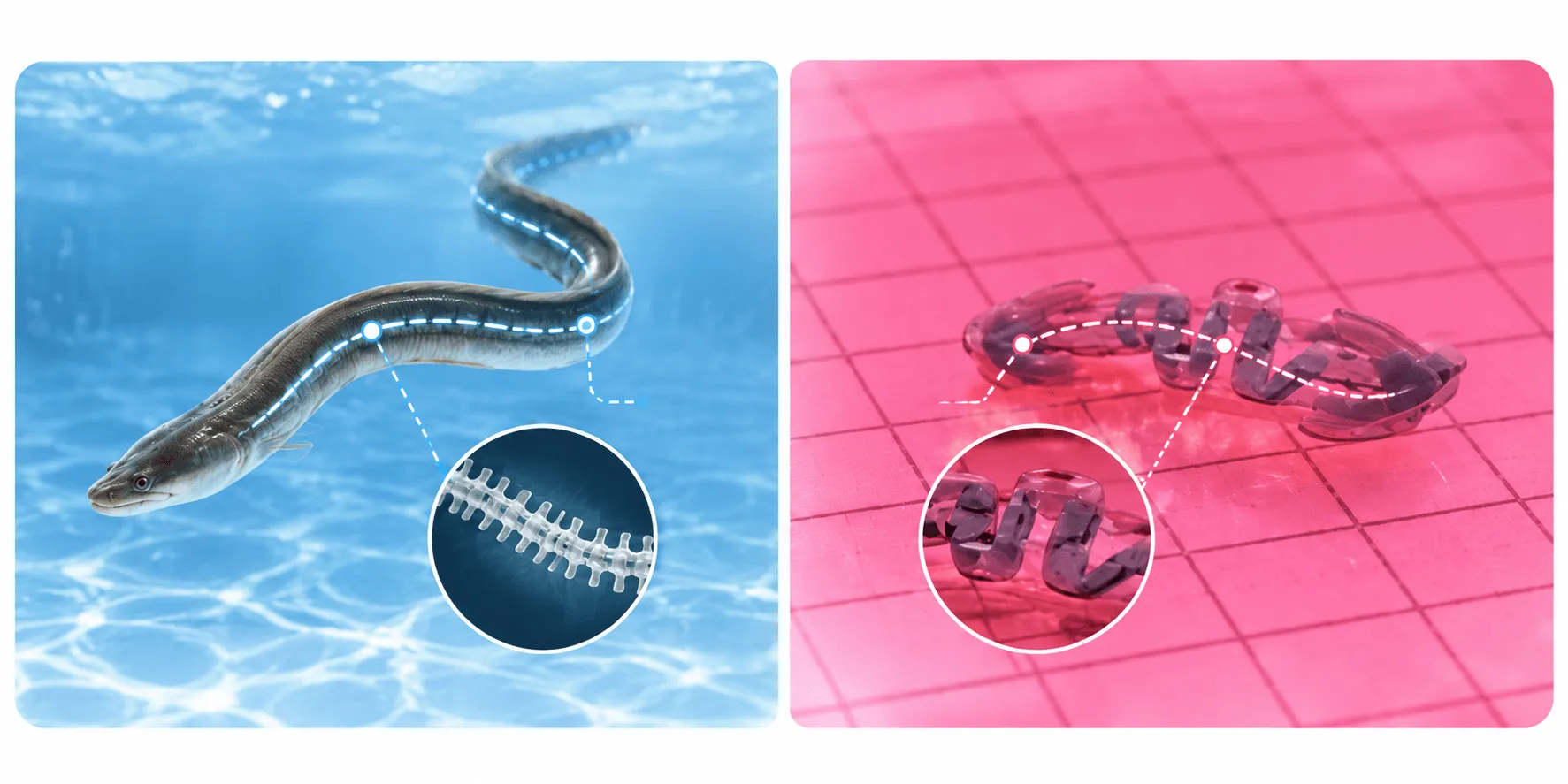
They turned to eels—creatures whose undulating spines convert small, rhythmic muscle contractions into fluid, efficient propulsion. The key insight? Elasticity. An eel’s spine isn’t just a structural support; it’s a spring-loaded energy storage system.
The team replicated this principle at the micro-scale. Using PDMS (a flexible, biocompatible polymer), they 3D-printed an artificial spine embedded with a microscopic spring mechanism. Living skeletal muscle cells were then grown directly onto this scaffold, forming a seamless bio-synthetic interface.
Here’s where the magic happens—and where this design diverges sharply from previous approaches.
In traditional skeletal muscle bots, each electrical stimulus produces one weak contraction, followed by passive relaxation. Movement is jerky and inefficient. In this new design, the spring does half the work:
A brief electrical pulse triggers the muscle to contract.
Instead of just pulling the body forward, the contraction compresses the internal spring, storing elastic energy.
When the stimulus stops, the spring snaps back, releasing that stored energy in a rapid, powerful thrust.
It’s the difference between pushing a swing once per cycle versus pumping it rhythmically to build momentum. The muscle provides the input; the skeleton amplifies the output. This self-stimulating feedback loop is what unlocks speeds previously thought impossible for skeletal muscle systems.
Perhaps the most lifelike feature is the robot’s dual locomotion strategy—something rarely seen in engineered micro-swimmers:
Gliding Mode: Gentle, sustained undulations mimic a small fish drifting near a riverbed. Perfect for low-disturbance environmental sensing or navigating delicate biological environments.
Burst Mode: Instant acceleration from standstill to top speed. In tests, the bot hit 800 µm/s—three body lengths per second. For context, that’s faster than any existing skeletal muscle bio-bot and rivals cardiac-powered counterparts, all while retaining full external controllability.
This behavioral flexibility isn’t just cool; it’s functional. Real-world environments aren’t uniform. A robot that can switch between stealthy cruising and rapid response is inherently more adaptable.
Yes, 800 µm/s is impressive for a 260 µm robot. But the real significance lies in what this design enables:
Targeted Medicine: Imagine micro-swimmers that navigate blood vessels with eel-like grace, delivering drugs to precise locations without triggering immune responses—all controlled externally via harmless electrical pulses.
Environmental Monitoring: Swarms of these bots could glide through waterways, detecting pollutants or microplastics in real time, their biocompatibility ensuring they don’t harm the ecosystems they’re meant to protect.
A New Design Philosophy: This isn’t just a better bot—it’s proof that mechanical intelligence (springs, levers, elastic structures) can compensate for biological limitations. Future biohybrids won’t need stronger muscles; they’ll need smarter skeletons.
For decades, robotics and biology have operated in parallel: engineers building machines that mimic life, biologists studying life that inspires machines. This eel-bot represents a true convergence—not imitation, but integration.
The Barcelona team didn’t just make a faster robot. They demonstrated that when we stop treating living tissue as a mere actuator and start designing with its native mechanics, the results transcend what either discipline could achieve alone.


 Contact
 Quote
 Account
 Cart

 English
 日本語
 한국어
 français
 Deutsch
 Español
 italiano
 русский
 português
 العربية