
Flexible electronics leverages the mechanical compliance of ultra-thin or high-aspect-ratio structures to overcome the limitations of conventional rigid devices in bending, folding, and conformal scenarios. Since the advent of flexible solar cells in the 1960s, advances in conductive polymers and organic semiconductors have continuously propelled the field. Current research has expanded beyond mere flexibility to encompass stretchability, self-healing, biocompatibility, and biodegradability, enabling applications in consumer electronics, implantable medical devices, and soft robotics. Despite its broad promise, significant scientific and engineering hurdles remain before widespread everyday adoption.
The materials architecture of flexible electronics spans three key layers: substrates, functional/interfacial layers, and interconnects.
Substrate Materials: Substrates must balance optical, thermal, and biocompatible properties with process compatibility. PET and PEN offer >85% transmittance and excellent bendability for displays and photovoltaics; polyimide withstands high processing temperatures; parylene provides superior biocompatibility for implantable devices; elastomers like PDMS enable stretchable designs; polyurethane and cellulose nanofibers address surface roughness and biodegradability, respectively. Future substrates must also conform to complex curvatures, endure repeated deformation, and be compatible with roll-to-roll manufacturing.
Functional and Interfacial Materials: 2D carbon nanomaterials (CNTs, graphene) combine high carrier mobility, electrical/thermal conductivity, and mechanical flexibility, widely used in sensing and biomonitoring. Organic semiconductors, tailored via molecular design, serve transistors, photovoltaics, and thermoelectrics; their tunable absorption/emission spectra are valuable for transparent displays and medical imaging. However, challenges persist in process reproducibility and air-stable n-type organic thermoelectrics.
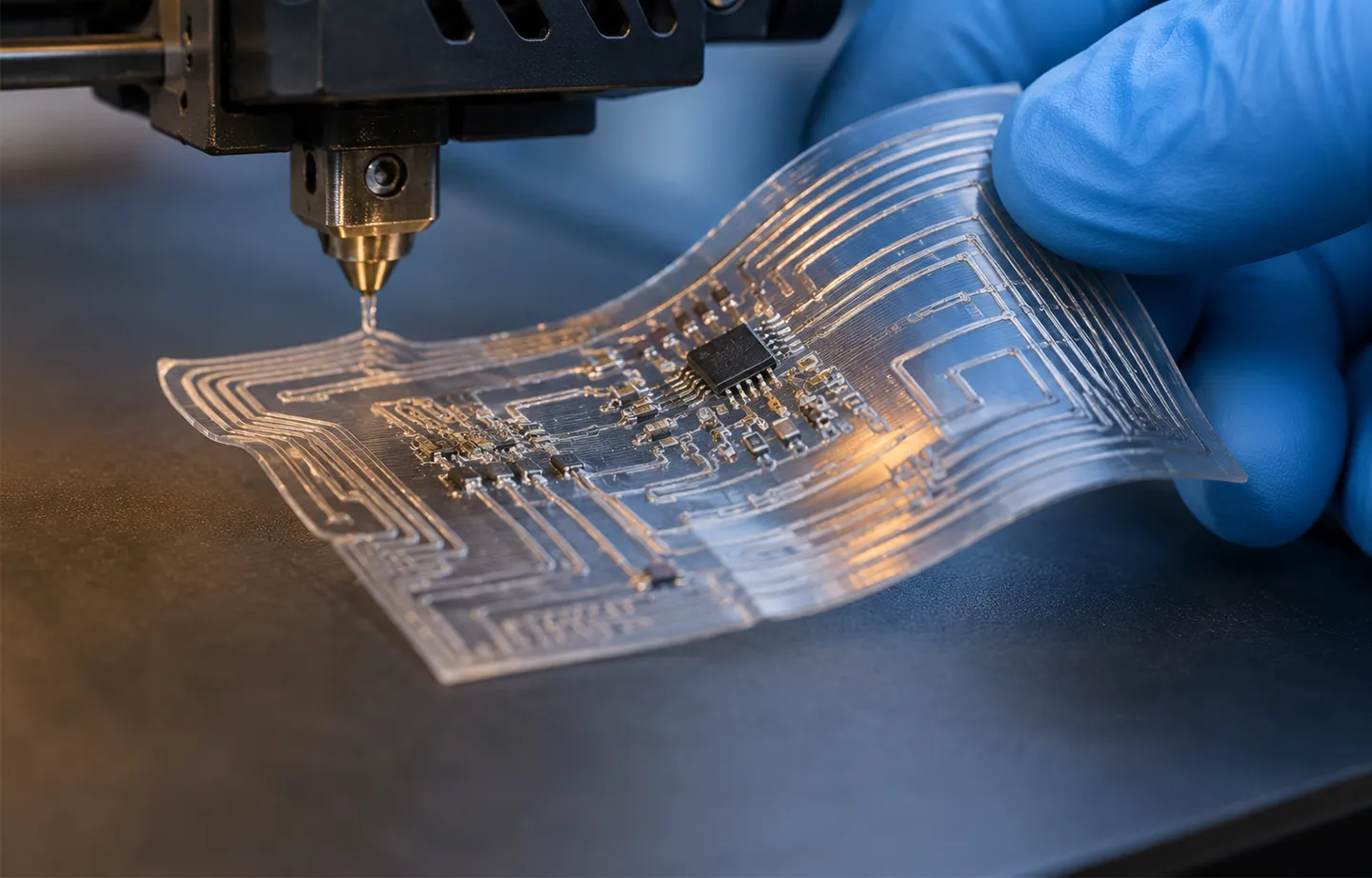
Interconnect Materials: The intrinsic brittleness of ITO limits its use in flexible systems. Solution-processable alternatives—graphene, silver nanowires (AgNWs), and conductive polymers—balance transparency and mechanical robustness. Metal nanoparticle inks enable printed conductive traces but face challenges in crack propagation control, oxidation suppression, and biosafety.
Flexible electronics manufacturing must achieve low cost and scalability. Key routes and their bottlenecks include:
Vacuum Deposition & Substrate Thinning: CVD and thermal evaporation deposit films on flexible substrates but demand stringent alignment precision. Backside grinding suffers from poor uniformity; wet/dry etching and stress-induced layer transfer improve standardization yet remain limited by brittle fracture, residual stress, and interfacial interconnection reliability.
Pattern Transfer: Films fabricated on rigid carriers are transferred en masse to flexible substrates, applicable to diverse device types. The core challenge lies in imprint dynamics—precise control of speed, contact area, and shear stress is required. Future progress hinges on interface engineering and non-contact transfer techniques.
Solution Printing: Combined with roll-to-roll (R2R) processing, this enables high-throughput large-area fabrication. Screen printing suits thick films but lacks nanoscale resolution; spray coating offers tunable film properties but struggles with material utilization; inkjet printing delivers high customization and repeatability, though ink viscosity, particle size, and solvent selection remain critical constraints.
Roll-to-Roll Compatible Techniques: Blade coating and gravure printing support high-speed continuous production, but industrialization is hindered by limited supply of functional materials and the need for eco-friendly solvents. Ink formulation optimization is pivotal.
3D Printing: Explored for interconnects and sensor prototypes, fully functional flexible electronics printing remains nascent. Advances require self-supporting inks and deposition strategies adapted to dynamic, conformal geometries.
Photovoltaics. Organic, perovskite, and quantum dot materials serve as active layers, yet fully flexible devices still lag behind rigid counterparts in power conversion efficiency. Progress depends on adopting flexible polymer substrates with AgNW electrodes, optimizing active layers, and simplifying processes for scale-up. Organic PVs must strike a balance between R2R compatibility and efficiency.
Bioelectronics. This is among the most promising growth areas in medical devices. Flexible electronics enables non-invasive, real-time monitoring of vital signs (heart rate, blood pressure, EEG, biomarkers), empowering early diagnosis and prevention, while extending to prosthetics, electronic skin, and smart drug delivery. Stretchability and biocompatibility confer inherent advantages, but commercial products still suffer from single-modality sensing, insufficient long-term biocompatibility, weak signal acquisition, and limited device lifetime.
Energy Storage. Energy storage units represent a critical bottleneck for system-level adoption. Flexible batteries and supercapacitors must overcome low volumetric energy density, high internal resistance, and poor mechanical durability. Carbon-based materials (graphene for supercapacitor electrodes, CNTs for Li-ion anodes) play a key role in performance enhancement; future efforts should integrate structural design, cost reduction, and self-powered system integration.
Communications & Antennas. IoT demands flexible, stretchable RF antennas, but current solutions exhibit residual rigidity, obtrusive form factors, human-body electromagnetic interference, and packaging reliability issues. Material innovation, frequency-reconfigurable designs, and low-cost substrate development are priorities.
Energy Harvesting. For space-constrained wearables, harvesters leveraging thermal gradients, kinetic energy, and triboelectricity are gaining traction. Single-mechanism efficiency is limited; hybrid architectures show improvement but face complexity, durability, cost, and material compatibility challenges. High flexibility remains essential for user comfort.
The core value of flexible electronics lies not in competing with silicon-based electronics on performance metrics, but in enabling new paradigms of interaction with complex, dynamic environments. Despite immense potential across energy, consumer, and healthcare sectors, device durability, manufacturing compatibility, and yield ramp-up remain primary barriers to commercialization. Future efforts should prioritize bioelectronics and personalized medicine, driving synergistic innovation across materials, devices, and systems to bring flexible electronics into clinical practice and daily life.


 Contact
 Quote
Quote  Account
  Cart
Cart 
 English